

Agentforce is getting a reasoning model built for CRM
The enterprise AI conversation is moving from answering questions to getting work done. On September 15, 2026, at Dreamforce, Salesforce and NVIDIA announced Koa, Salesforce's first CRM reasoning model for Agentforce. Koa is built on NVIDIA Nemotron and was developed through deep technical collaboration with NVIDIA. Its job is narrower than a general-purpose model's: work through multi-step tasks and pick the right tool at each step. [1][2][4]
General models reason from scratch every time
Salesforce treats reasoning as the whole loop behind an agent's action: think it through, check the logic, pick tools, confirm the path.
A frontier model brings one broad kind of intelligence to every task, whether it's a refund question or a physics problem. Salesforce's engineers see that as both its strength and its limit. Because it starts from first principles each time and reasons probabilistically, the answer can shift between runs.
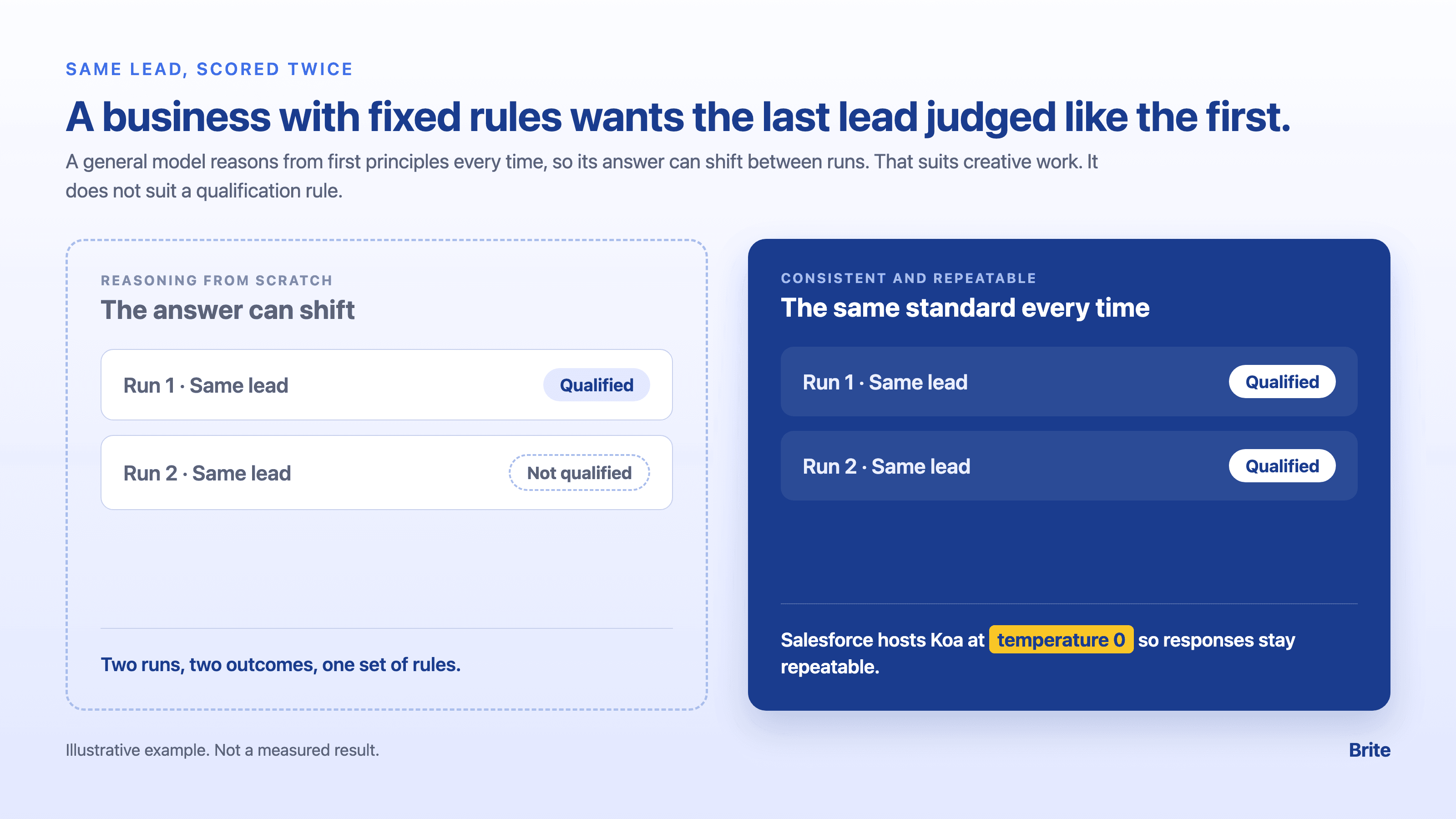
That flexibility suits creative work. When a business has fixed rules for qualifying leads, it wants the last lead judged by the same standard as the first.
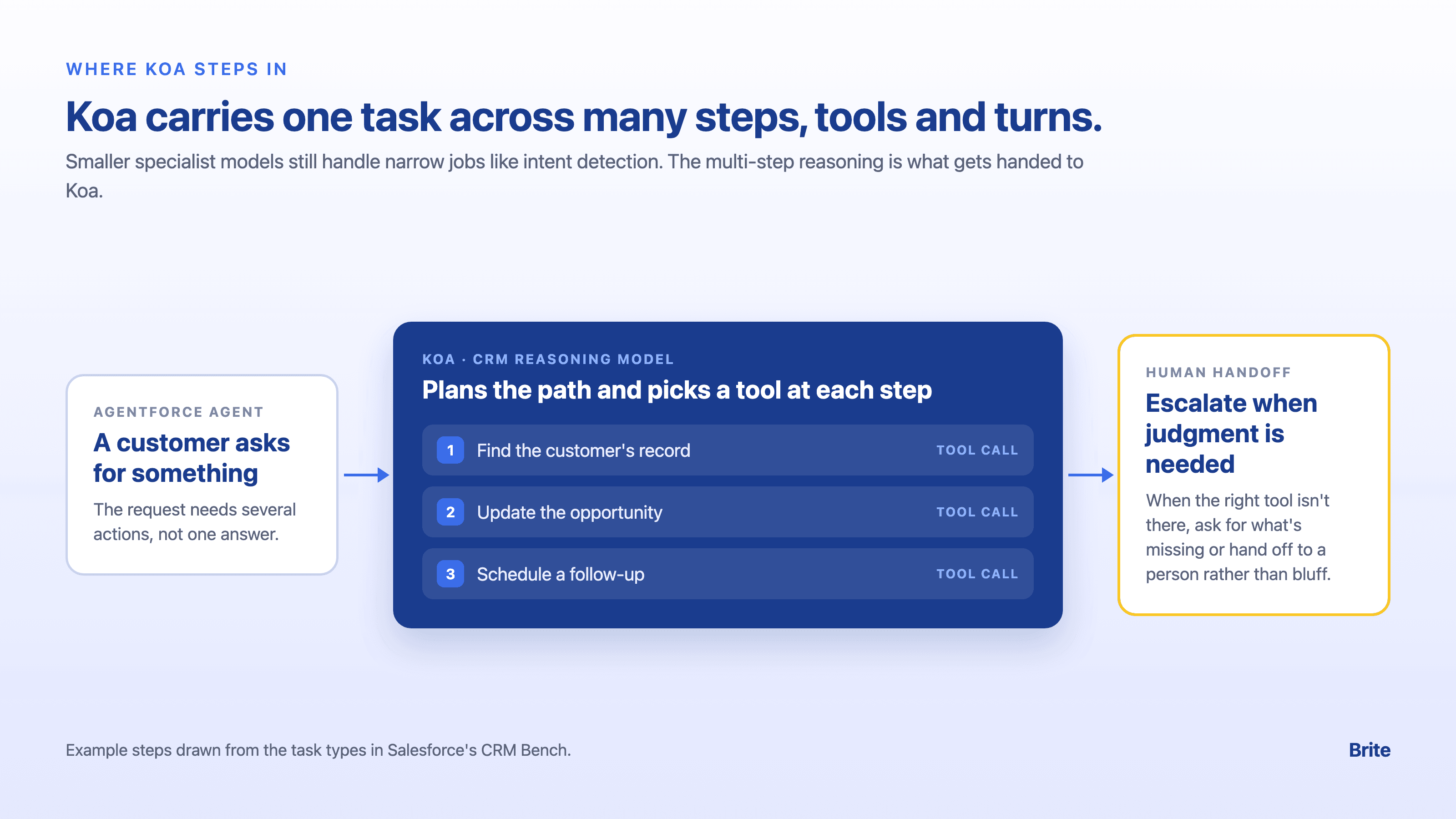
Until now, one general model did heavy multi-step reasoning in Agentforce, even though Salesforce had already moved jobs like intent detection and toxicity screening to smaller models. Koa steps in at that point. It is meant for the moments when an agent has to carry a task across many steps, tools, and turns of conversation.
Salesforce trained Koa on simulated customers
Salesforce started with NVIDIA Nemotron 3 Super, an open model with 120 billion parameters. Salesforce valued it for two reasons: It gave access to the model weights, and NVIDIA's public release of the training datasets, which lets teams inspect what the foundation was built on.
From there, Salesforce built a proprietary synthetic dataset modeled on nearly three decades of CRM deployments, which Salesforce and NVIDIA describe as 27 years of CRM intelligence. Each simulated scenario started with a persona and a set of tasks, then charted the actions and tool calls needed to complete the work. The scenarios span more than 14 industries, including manufacturing, financial services, healthcare, and travel.
The training method is the interesting part:
- Supervised fine-tuning (SFT): the model learns from examples of work done well. Salesforce says this alone gave limited gains, because enterprise agents run multi-turn workflows with tool calls, and that kind of work is hard to learn from examples alone.
- Reinforcement learning with GRPO: in simulation, the model works with made-up customers who range from friendly to irritated. Tools answer its calls, a judge decides whether the problem got solved, and the model keeps retrying across thousands of runs to raise its score.
Salesforce used NVIDIA NeMo RL, NeMo Gym, and NeMo AutoModel for post-training.
One scenario is worth singling out. Salesforce deliberately put the model in situations where the right tool wasn't available. Rather than bluff, Koa learned to admit the gap, request what's missing, or escalate to a person when the call needs human judgment.
The numbers are promising, and they're Salesforce's own
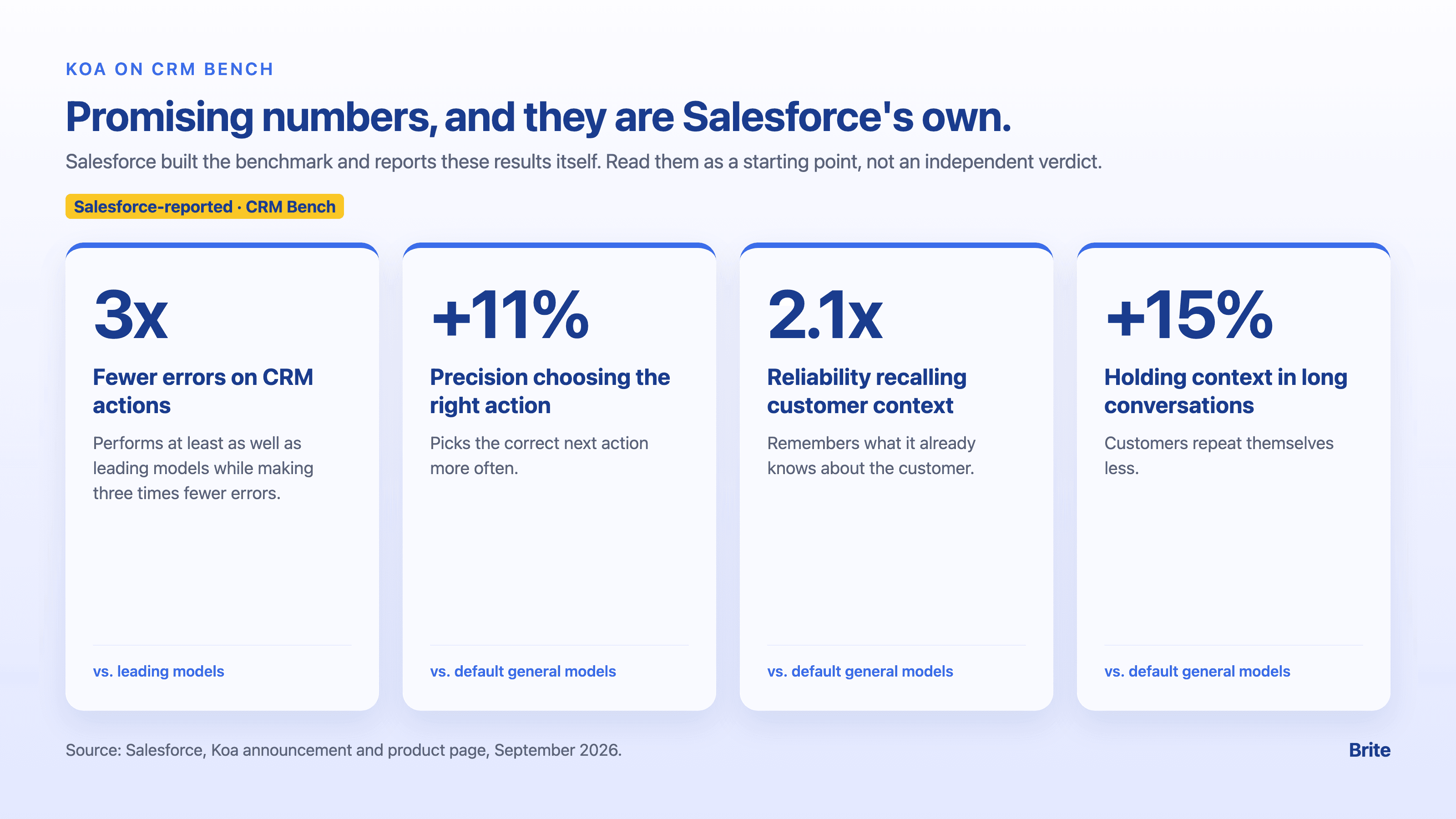
Salesforce calls itself "customer zero" and has been testing Koa internally across several agent types. Salesforce measured Koa on CRM Bench, a benchmark built from real-world CRM tasks such as updating an opportunity, routing a case, and scheduling a follow-up. On CRM actions, Salesforce says Koa performs at least as well as leading models while making three times fewer errors. Salesforce built the benchmark and reports the results itself, so they are a starting point, not an independent verdict. Against default general models, Salesforce reports:
- Choosing the right action: 11% more precise.
- Recalling customer context: 2.1 times more reliable.
- Holding context in long conversations: 15% better, so customers repeat themselves less.
Salesforce says your data never trains Koa
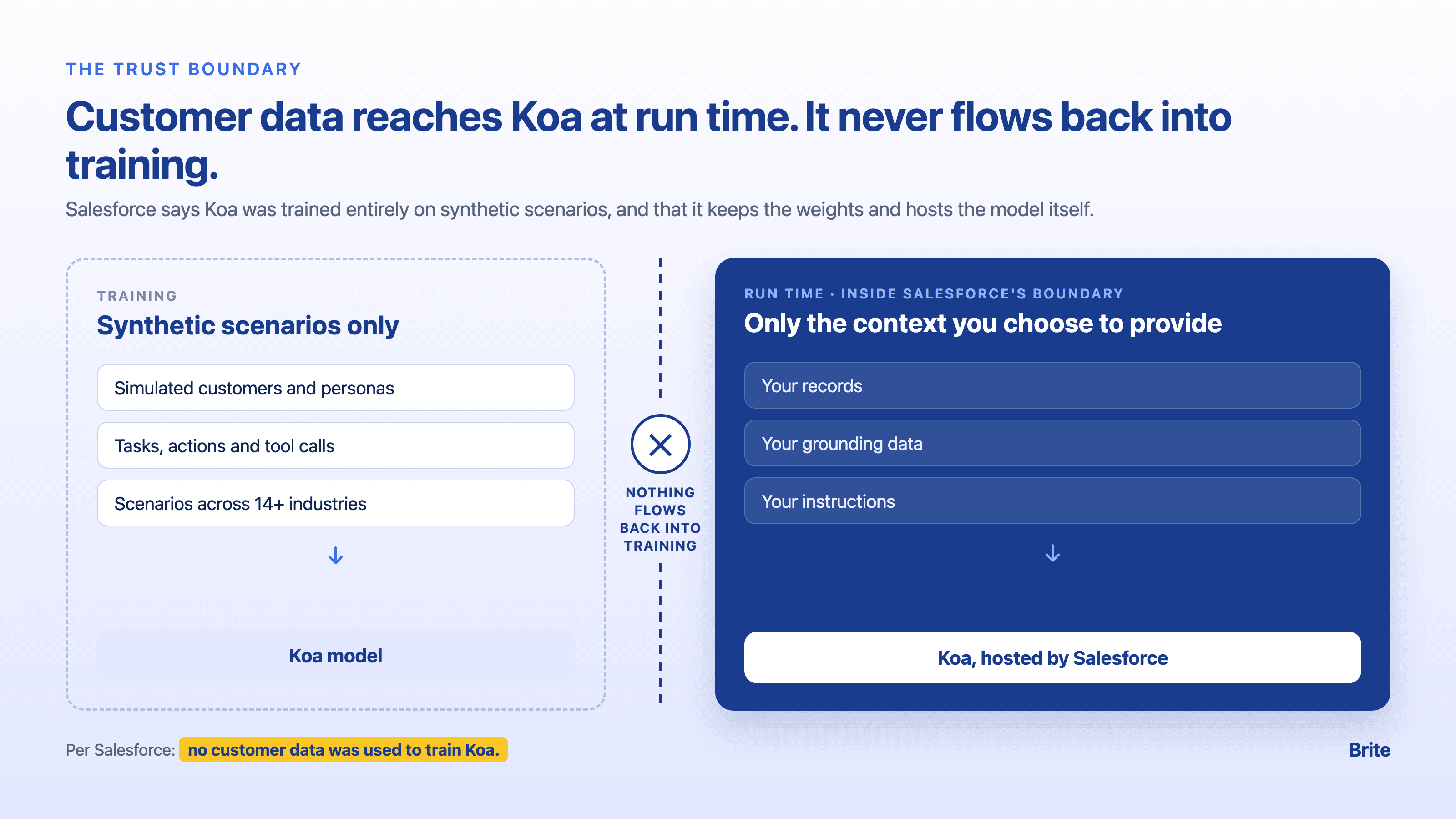
Data is usually the first worry with any AI agent, and here's the headline: Salesforce says no customer data was used to train Koa. Its training corpus was built entirely from synthetic scenarios, and Salesforce keeps the model weights and hosts Koa itself. The company says customer data never leaves that boundary, in training or in use.
A few more details show how that works. Customer data and reasoning traces don't train the model. Customers also decide what context Koa gets, since it works only from the records, grounding data, and instructions they provide. Koa is hosted at "temperature 0," which means the randomness is taken out of how the model picks each next word, so responses stay consistent and repeatable. On top of that, a dedicated serving harness adds trust and safety controls around the model itself.
Government and regulated teams are part of this story too. Missionforce, Salesforce's offering for government and highly regulated organizations, is getting Nemotron-based models and NVIDIA's accelerated computing, so customers in sensitive industries can train, tune, and run their own mission-specific models on their own data, even inside air-gapped networks. Salesforce points out why that matters: these buyers need control over the model, the data, and the environment it runs in. On the product side, Missionforce Operations automates government workflows like procurement, supplier management, and logistics, and it launched as generally available in U.S. regions. The post-trained NVIDIA models that will power its agents become available to select customers in October 2026.
You can start Koa with a single agent
You have a few ways in, and Salesforce describes three:
- Agent or sub-agent level: pick Koa for a specific agent, sub-agent, or router in Agentforce Builder.
- Org-wide: turn it on as a model provider in Agentforce Setup. Customers opt in, like any other provider.
- Data Cloud: use it as a managed LLM from the generative models catalogue.
Koa also doesn’t work alone. Salesforce sends narrow jobs, such as classifying intent or reranking search results, to smaller specialist models and leaves the multi-step reasoning to Koa. [2] [3]
Koa already runs inside Salesforce, and customers are next
Koa isn't just an announcement. It already runs inside Salesforce, including in an employee agent in Slack that helps people find information and complete everyday tasks. Customer pilots are next, with 1-800Accountant, Baxter Credit Union, Engine, Formula 1, UChicago Medicine, and Xero. NVIDIA, for its part, says it runs on Salesforce across sales, service, marketing, and operations, and is piloting Agentforce for customer-support workflows.
Koa is available to select pilot customers now. Salesforce expects general availability in U.S. regions in winter 2026, with an open beta planned shortly after. As for pricing, neither the press release nor the product page mentions it.
If Koa delivers, agents could become dependable teammates
Here is what makes Koa exciting. Most of us have watched an AI agent lose the thread halfway through a customer conversation, or confidently do the wrong thing. Koa was built to close that gap, and Salesforce's early numbers suggest it is aiming at the right target: fewer wrong actions, better memory across long conversations, and a model that stops and asks for help instead of guessing.
Imagine an agent that remembers what a customer said ten messages ago, picks the right tool the first time, and hands off to a person exactly when judgment is needed. Multiply that across every service case, every follow-up, and every lead in your org. That's the shift pilot customers are hoping for. 1-800Accountant expects to stretch its accountants' knowledge further across customer conversations, and UChicago Medicine expects Koa to give teams more time and capacity for patient care.
These are expectations but the pieces are falling into place: a model trained on the work itself, a trust boundary that keeps customer data out of training, and the option to switch it on for a single agent and see for yourself.
General availability is expected in winter 2026. If Koa lives up to what Salesforce is reporting, Agentforce agents could go from impressive demos to dependable teammates. That is the story to follow between now and then.